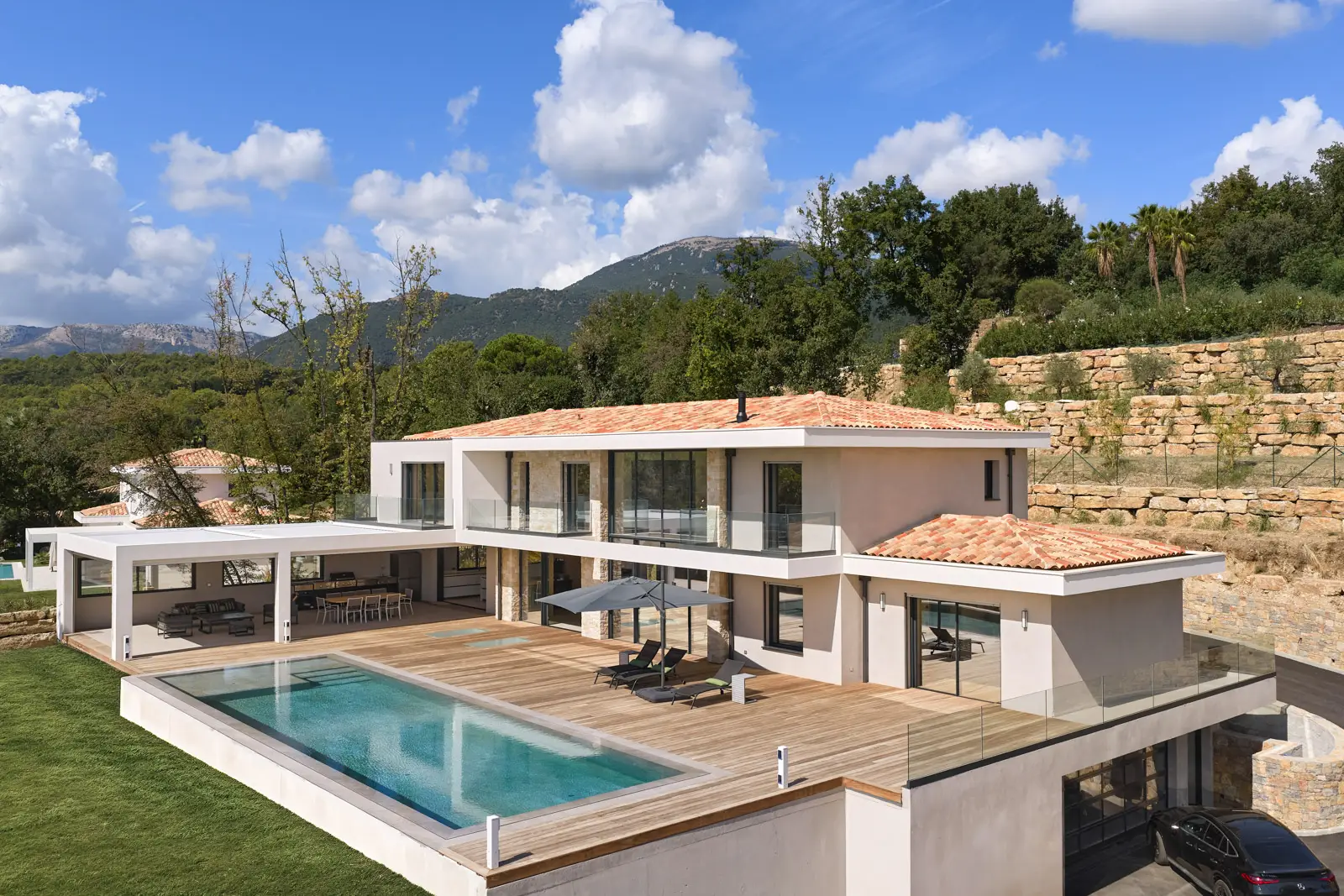
SoléaRoquefort-les-PinsBuilt by Midi Mas
Building plots around Le Rouret · From Cannes to Monaco
Before you buy a plot in Le Rouret, find out which villa it will allow.
A listing shows a surface area, a view, sometimes a permit. It rarely tells you what you will see from your living room, what the slope and its dry-stone terraces (restanques) will demand, or what the town’s rules will let you build. Come with us to visit the plots we present, and see them through a builder’s eye: we have been designing and building villas since 1993.
More than 400 completed villas400
Our building sites are open to visitors: villas at every stage of construction, from structural work to finishes.
What surface area does not tell you
Three plots, almost the same size. Three houses with nothing in common.
Take three plots we have presented in Mougins. Their listings use almost the same words: sought-after area, peace and quiet, easy access. Seven square metres separate the first two. Yet here is what has been approved or deemed feasible on each:
-
Plot
4,270 m2
Permit granted
A 345 m2 villa
With a pool.
-
Plot
4,277 m2
Feasible
A villa of up to 600 m2
With a pool and garage.
-
Plot
4,477 m2
Permit granted
Two villas, 330 and 290 m2
With pools and garages.
Based on the details of the plots presented by Midi Mas in 2024 and 2025. Bars: villa floor area, to the same scale.
The difference has nothing to do with surface area. It comes from the shape of the plot, its slope, its access, the planning rules that apply to it, and the project chosen for it: a permit fixes one project, not necessarily everything the plot allows. All of this can be read on site and on the plans, provided you know where to look.
You do not buy a plot by the square metre. You buy it for the house it allows.
The plots we present
Building plots around Le Rouret, from Cannes to Monaco.
Each one is described by what it allows, not just by what it measures. Several already have a building permit (permis de construire). Price and availability, confirmed with the seller, and the status of the permit: we give you all of this in our very first conversation, plot by plot.
Around Le Rouret
13 plots- Photos on request
Châteauneuf-Grasse
2,300 m2
Peaceful neighbourhood, panoramic view over Plascassier. Permit granted for a 220 m2 villa with pool and basement garage.
Visit this plot Tourrettes-sur-Loup
1,250 m2
In the hills, in a peaceful neighbourhood. More than 300 m2 of living space feasible, with pool and garage.
Visit this plotValbonne
1,266 to 1,550 m2
Several plots on the edge of the village, in a planned subdivision (lotissement). Ground coverage allowed: 320 m2 per plot.
Visit this plotBiot
1,813 m2
Domaine de la Chèvre d’Or, in the hills. Permit granted for a 244 m2 villa with pool and garage.
Visit this plotMougins
4,477 m2
Permit granted for two villas of 330 and 290 m2, with pools and garages.
To check on site: how each house keeps its privacy and its view.
Visit this plotMougins
4,277 m2
A villa of up to 600 m2 is feasible, with pool and garage.
To check on site: where to place 600 m2 so that the living spaces face the right way.
Visit this plotMougins
4,270 m2
Permit granted for a 345 m2 villa with pool.
To check on site: what the permit already fixes, and what can still be adapted to the way you live.
Visit this plot- Photos on request
Mougins
1,542 m2
100 m from the centre of Mougins. Permit granted for a 300 m2 villa with pool and basement.
To check on site: from which floor of the house you still glimpse the sea.
Visit this plot Mougins
1,050 m2
Close to the centre, panoramic view over the plain of Grasse. Permit granted for a 178 m2 villa with pool.
To check on site: how to turn the house towards the plain and its far horizons.
Visit this plotVence
1,688 m2
On a gated estate, south of Vence. Permit granted for a 310 m2 contemporary villa with pool and garage.
Visit this plotVence
5,389 m2
In the hills, in a highly sought-after neighbourhood, with a view along the whole coast. Ground coverage allowed: 15%.
Visit this plotLe Cannet
1,550 m2
In a highly sought-after neighbourhood. Permit granted for a 350 m2 contemporary villa with pool and garage.
Visit this plot- Photos on request
Le Cannet · chemin des Collines
1,200 m2
Highly sought-after, quiet neighbourhood. Permit granted for a 262 m2 contemporary villa with pool.
Visit this plot
Further afield
From Cannes to Monaco- Photos on request
Cannes · Super-Cannes
3,500 m2
Within the Super-Cannes estate. Permit granted for a 250 m2 villa with pool.
Visit this plot Golfe-Juan
1,393 m2
Panoramic view of the Lérins Islands. Permit granted for a 360 m2 villa with pool and garage.
Visit this plotMandelieu-la-Napoule
1,398 m2
In the hills, in a quiet neighbourhood. Permit granted for a 240 m2 contemporary villa with pool and garage.
Visit this plotMandelieu-la-Napoule
3,372 m2
In the hills, facing the bay of Cannes and the Esterel. Permit granted for four apartments with pools; one or two villas, up to 800 m2, are also feasible here.
Visit this plot- Photos on request
Nice · Mont-Boron
3,008 m2
View over the bay of Villefranche. Permit granted to divide the land into two plots, extend the existing villa and build a second villa with pool and garage.
Visit this plot - Photos on request
Villefranche-sur-Mer
1,183 m2
Close to the centre, panoramic sea view. Permit granted for a 360 m2 villa with pool and garage.
Visit this plot Beaulieu-sur-Mer
1,000 m2
Close to the centre, panoramic sea view. Permit granted for a 211 m2 villa with pool and garage.
Visit this plotÈze
1,400 m2
In the hills, with views of the village and the coastline. A 360 m2 villa with double garage and pool is feasible here.
Visit this plotÈze
1,006 m2
Close to the centre, sea view. Permit granted for a 285 m2 villa with pool and garage.
Visit this plot- Photos on request
Èze
1,000 m2
Easy access, sea view. Permit granted for a 360 m2 contemporary villa with pool.
Visit this plot Èze · Saint-Laurent-d’Èze
1,600 m2 each
Three plots close to Monaco, sea view. Permit granted for three villas of 260 to 300 m2 with pools and garages.
Visit this plotLa Turbie
1,449 to 2,836 m2
Several plots in the hills, easy to reach, sea view. Villas of 320 to 580 m2 feasible, depending on the plot.
Visit this plot
Midi Mas presents these plots with a view to designing and building your villa on them. The plot details were published in late 2024 and updated in early 2025: since then, some plots may have found a buyer, some permits may have expired, and the planning rules of several towns have changed (in Mougins, for example, the local zoning plan, or PLU, was amended in December 2025). We confirm everything, plot by plot, in our first conversation.
None quite right? Show us the plots you spot, in Le Rouret or anywhere from Cannes to Monaco: we look at them with you, through a builder’s eye, before you decide to buy.
Visit plots with us- 1On the day of the visit, from the highest point: the horizon.
- 2From the living room, a few metres lower: the neighbour’s roof.
- 3The setback required by the planning regulations, which decides where the house can stand.
- 4The retaining structure the slope calls for.
- 5What the neighbour is still entitled to build.
What a listing does not show
You look at the view. We look at where you will see it from.
A plot in Le Rouret, one Saturday morning. The gate opens onto a gentle slope cut into dry-stone terraces, planted with olive trees and a few pines; from the top of the plot, you can just make out a thin ribbon of sea in the distance. It is what the listing promised, and it is true.
You do what everyone does: you climb to the top of the plot, where the view is finest, and you are already picturing the terrace right where you stand.
But your living room will not be there. It will be lower down, or further back: wherever the slope, the setbacks required by the planning regulations and access for construction machinery allow it to sit. That day, you will no longer be standing on a plot. You will be sitting in your own home. That is where the plot will have to keep its promises.
We, for our part, stay down below for a while. We look at where the construction machinery will come in, where the hill’s shadow will fall on a December afternoon, what the zone’s regulations allow here, in height as well as ground coverage, and what the neighbour could build tomorrow between you and the view. Then we climb back up, and ask the only question that counts: from your living room, what will you see?
Sometimes the answer confirms the plot you fell for. Sometimes it turns your heart towards another, less photogenic in its listing but better able to carry the house you want to live in. Either way, you decide with full knowledge of the facts.
Everyone looks at a plot through the lens of their own trade. Ours is building a villa on it.
The estate agent knows the market, the surveyor measures the plot, the notary (notaire) secures the sale, the architect draws: each has a role. But it is by building that you learn what a slope, an access road or the ground itself really demands of a house. Since 1993, we have done both: design, then build. And that eye matters before you sign: unlike buying a house, buying a building plot in principle gives you no cooling-off period, except in a subdivision that requires a development permit (permis d’aménager).
A builder’s eye
Nine questions we ask of every plot before we draw a villa on it.
Here is what we examine, on site and on the plans. Keep this list: it will serve you on every plot you visit, with or without us.
How many square metres of footprint does this plot allow?
For a new villa, sometimes none. A large share of the villa neighbourhoods in Le Rouret falls within sector Nh of the local zoning plan (PLU), where only outbuildings, a pool and extensions to existing houses are permitted. In zone Uc, ground coverage is limited to 17% of the part of the plot that lies within the zone, and each building must stand back from the boundaries by at least its own height: 7 metres minimum from the side boundaries, 5 from the rear boundary.
What will you see from the living room?
A view is judged from the level you will live on, not from the highest point of the plot. In Le Rouret, the sea can only be glimpsed, far off, from certain spots, often between the trees and the rooftops; to the north, the view takes in the Pre-Alps. In zone Uc, height is limited to 7 metres, measured from natural ground level to the eaves, and to one storey above the ground floor. That leaves the question of what your neighbours will still be allowed to build.
Is the villa you have in mind allowed there?
Rules on appearance also shape your house. In zone Uc, at least 70% of the roofs must be in curved canal tiles, flat roof terraces must remain very much the exception, and pure white is prohibited on façades. Within 500 metres of the Château du Rouret, a project visible from the monument, or visible together with it, requires the approval of the state heritage architect (Architecte des Bâtiments de France). Finally, the local zoning plan, which has been under revision since December 2025, may change.
Is the plot in a red zone?
In Le Rouret, only one risk prevention plan has been approved: the wildfire risk prevention plan (PPRIF), in 2006. In the red zone, new construction is in principle prohibited. The blue zone is buildable subject to conditions: in sectors B0 and B1, a new house must stand no more than 150 metres from a standardised firefighting water point, and in B0, building may begin only once protective infrastructure approved by the prefect has been completed. This is checked plot by plot.
What does the ground tell you?
On the government’s Géorisques map, most of Le Rouret shows high exposure to clay shrink-swell, the rest medium exposure. In these zones, the seller of an undeveloped building plot must give you a preliminary geotechnical study (étude géotechnique préalable). It describes the site, not your house: your villa’s foundations are worked out with the design. Géorisques also records, in Le Rouret, six droughts officially recognised as natural disasters between 2003 and 2022.
What will the slope cost?
A slope offers levels, terraces, often the view. It also calls for earthworks, which have their own rules in zone Uc: dry-stone terraces (restanques) outside the footprint of the house must be preserved, any bank higher than 50 centimetres must be held by a wall of local stone, olive trees must be moved, not felled, and at least 40% of the plot must remain unsealed open ground, 60% in ecological corridors.
How will the machinery get in?
A lane that is charming by car can become a real issue for construction machinery. In zone Uc, the access drive may not exceed a 5% gradient over its first 6 metres, or 15% beyond that. In every zone, any new ground coverage must be offset by a rainwater retention basin of at least 100 litres per square metre of sealed surface. Mains sewer connection or on-site wastewater treatment (assainissement autonome), emergency access: all of it is examined before you buy.
Has the permit been granted, or is it beyond challenge?
A third party can challenge a permit in court for two months from the first day it is continuously displayed on the plot; without proper display, that period does not start to run. The mayor can also withdraw an unlawful permit within three months. A permit has a period of validity and can be transferred to the buyer only on application to the town hall, with the agreement of its holder. The conditions that protect you are written into the preliminary contract (avant-contrat), with your notary (notaire).
What is it like at 8 am on a Tuesday?
A Saturday visit tells you nothing about weekday traffic. In Le Rouret, the RD 2085, a designated major traffic route that runs through the town, is in category 4 of the road noise classification: the noise-affected zone extends 30 metres on either side, as it does along a stretch of the RD 7. Come back on a weekday and, if possible, in winter, when the sun is low.
None of these questions is a reason to give up on a plot. A slope can offer a view that flat land never will; an existing permit is a valuable starting point. But every one of these questions will come up one day.
Before you sign, it is a question, and it has an answer. Afterwards, it is a constraint.
Rules cited: the local zoning plan (PLU) of Le Rouret (general provisions, zone Uc and sector Nh; version resulting from simplified amendment no. 2 of 19 December 2024, enforceable since 20 January 2025; revision no. 1 formally launched on 18 December 2025, with the planning and sustainable development strategy, or PADD, debated a second time on 23 July 2026), the protected surroundings (abords) of the Château du Rouret, a historic monument (the Heritage Code, code du patrimoine), the wildfire risk prevention plan (PPRIF) approved by prefectoral order of 27 July 2006, the road noise classification (prefectoral order of 18 August 2016), Géorisques data (consulted in October 2026), the Planning Code (code de l’urbanisme), the Construction and Housing Code (code de la construction et de l’habitation). They vary from one zone to another: every plot must be checked.
These questions are not settled by reading a listing. They are settled on site, plans in hand. That is exactly what we do during a visit.
Visit plots with usFrom plot to villa
What a plot becomes, when you know how to read it.
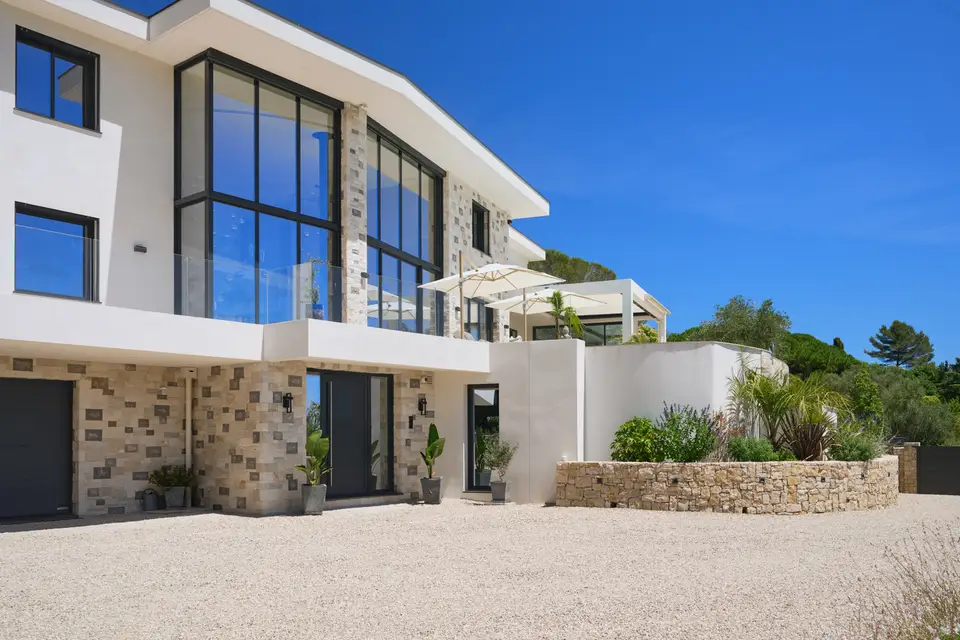
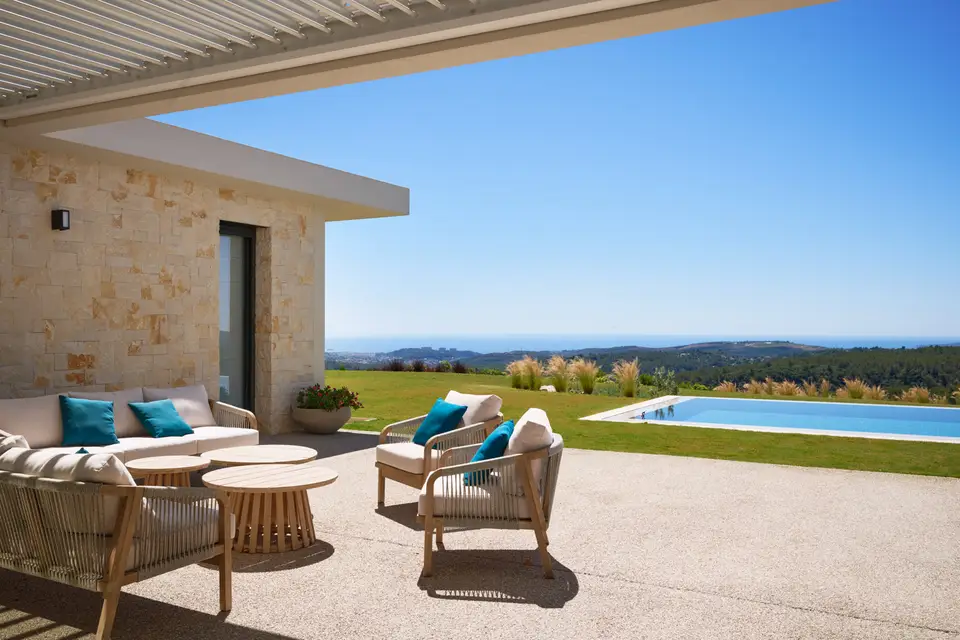
A slope, a view, an orientation: every plot sets its own conditions. In these villas, the house began with the plot. What these photos no longer show (earthworks, retaining structures, the structural frame), you will see on our building sites, which we open to visitors at every stage of construction.
-
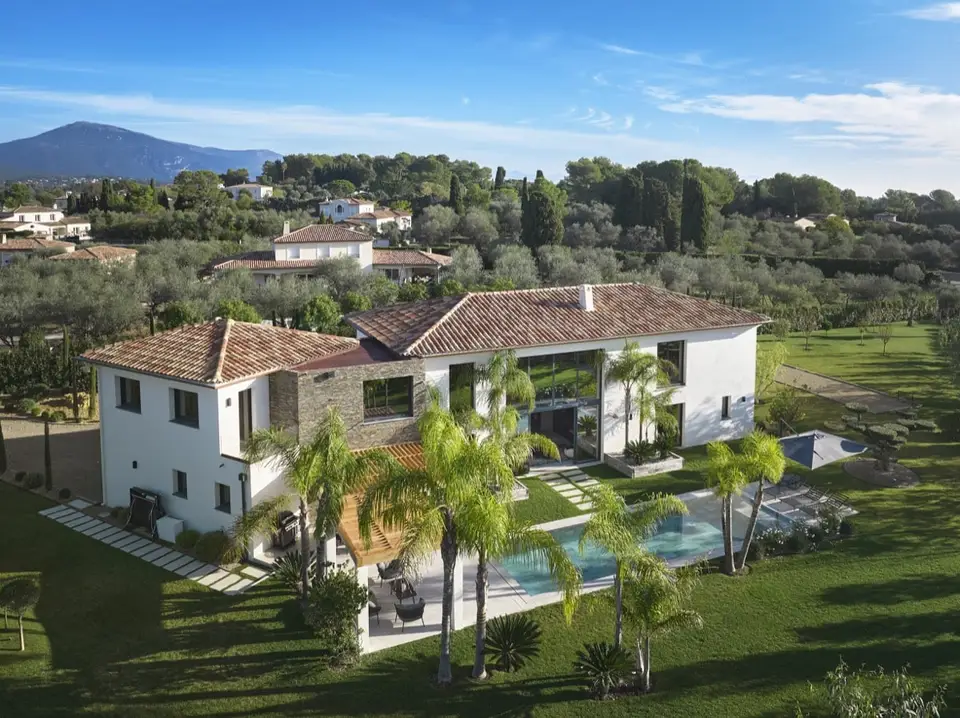
Anse d’argent
Le CastellarasThe plotAn open plot among the olive groves, facing the mountains.
The answerA double-height living room whose glazing brings the garden and the pool right into the sitting area.
-
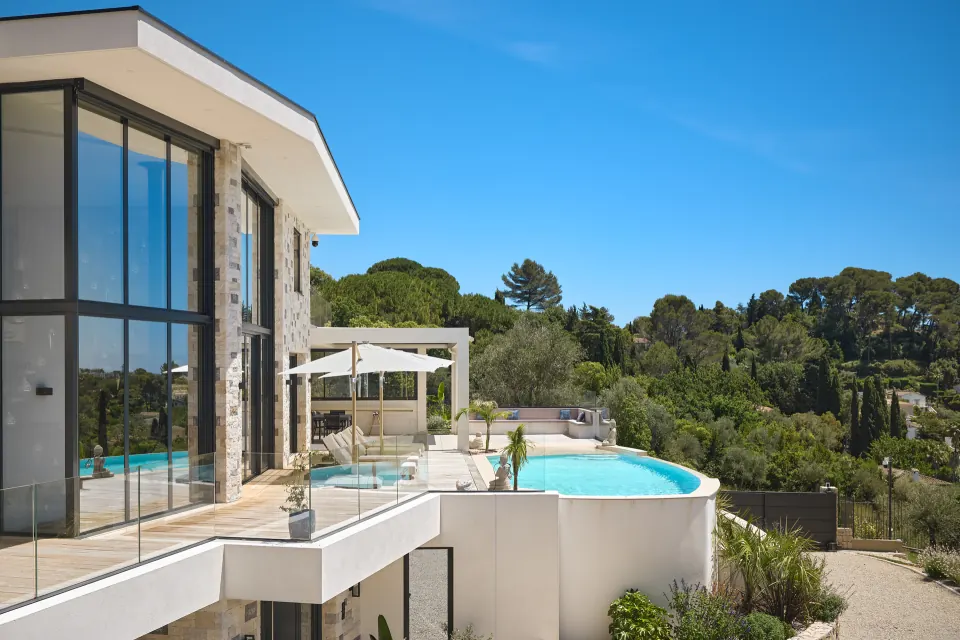
Sillage
The plotA slope facing the landscape.
The answerThe terrace and pool reach out towards the view, above the lower level.
-
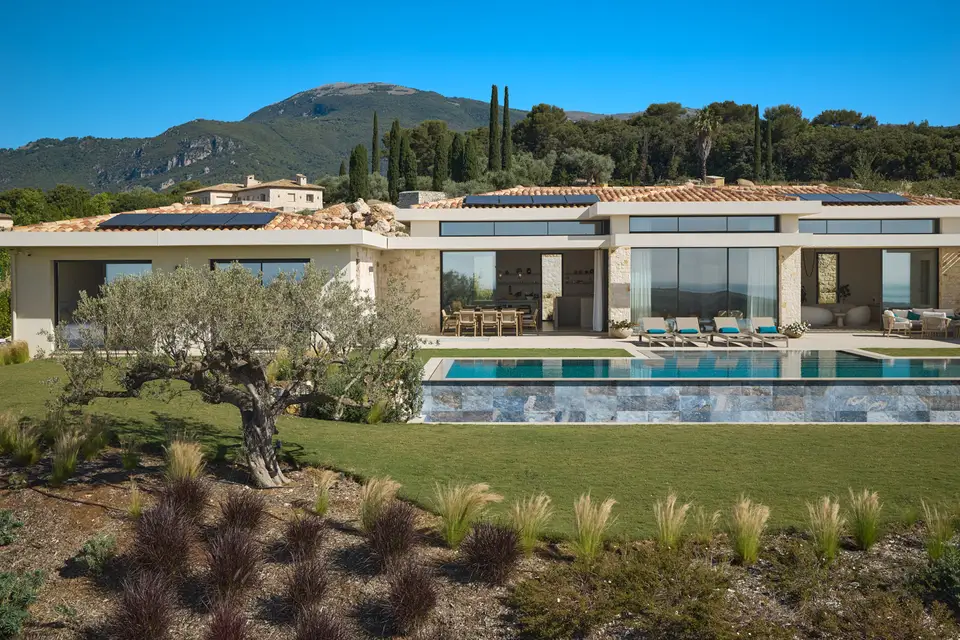
Rivage
Roquefort-les-PinsThe plotA distant view to capture.
The answerOn a single level, the entrance, the living room, the terrace and the pool line up with the landscape: your eye travels through the house before your feet do.
Photographs of villas built by Midi Mas.
Press
Midi Mas, une signature haute couture
The plot visit
Let’s visit the plots that interest you, together. Before you sign, you will know which villa each one allows you to build.
Don’t take our word for it. Come and look, with us, on site.
- A first conversationYou tell us what you are looking for and the life you want to live in this house. We select the plots that could fit, and confirm their availability.
- Visiting the plotsOn each plot, we look with you at what the listing does not say: where the living room would sit, the path of the sun, the slope and what it would call for, the access, the neighbours, the planning rules.
- Our building sites, at every stageWe take you to see villas under construction, from structural work to finishes: what a real plot demands of a real house, and how we respond. You judge our work on the evidence, including what a finished villa no longer shows.
What you take away
- a clear reading of every plot you visit;
- the questions to ask of any plot;
- a precise idea of the house that could stand there.
Have you spotted a plot elsewhere in our area? Mention it in the form: from our very first conversation, we will work out together how to look at it with the same eye before you decide to buy.
A plot is chosen in a few weeks. Your house will stand on it for decades.
Visit plots with usBefore you write to us
Who this visit will be useful to, and who less so.
It will probably be useful to you if
- you are looking for a plot on which to have a villa of 200 to 1,200 m2 built, in Le Rouret or between Cannes and Monaco;
- you have spotted a plot, or not yet: either way, now is the right time;
- you would rather understand a plot before buying it than after;
- you care as much about the quality of construction as about the location.
It will probably be less useful to you if
- you are looking for a plot to invest in or resell, with no plan to build a house;
- you want a house you can move into straight away: buying an existing villa will no doubt meet that need better;
- you are searching outside our area.
Does the first list sound like you? What happens next is simple.
Visit plots with usFrequently asked questions
The questions to ask before you buy a plot.
Is your question not listed here? Keep it for our first conversation: we will answer it in person.
Are the plots presented here still available?
They were presented in 2024 and 2025, and some may have found a buyer since. Tell us what you are looking for: we will tell you which remain available and, with the seller’s agreement, arrange a visit to those that suit your project.
Why are prices not shown on this page?
Because a published price ages quickly: these details date from 2024 and 2025, and a price may have been revised since. In our very first conversation, before any visit, we give you the current price of each plot that interests you, with its availability and what it allows you to build. That is how you really compare prices: two plots at the same price can carry two villas with nothing in common.
If a permit has already been granted, do I have to build the house it describes?
No. A permit proves that a project was judged compliant with the planning rules on this plot: that is valuable information. But it was drawn for someone other than you. If it matches the house you want to live in, it can be transferred to you with its holder’s agreement, as long as it is valid: you then avoid having a new application processed. If not, it makes way for a new application for the villa you really want. We go through this with you, plot by plot.
I don’t have a plot yet. Is it too early to contact you?
No, it is actually the best time. You read a plot better when you already know how you want to live on it, and you avoid buying a plot that will not allow the house you imagined. We can help you choose the right plot.
I have spotted a plot that is not listed here. Can you look at it with me?
If it is within our area and you are thinking of having your villa built on it, we can advise you before you decide to buy, with a technical analysis of the plot if needed. Name its town in the form: we will discuss it in our very first conversation.
What happens after the visit?
You leave with a precise reading of the plots you visited: what each one allows, what it demands, the house it could carry. If one of them convinces you and our way of working suits you, we move on to designing your villa. If not, you will look at the next plots with a different eye.
I don’t live in the area. How does the visit work?
The first conversation takes place remotely: together, we shortlist the plots worth the journey, with their price and availability. The visit is then arranged for a date that fits your next stay on the French Riviera, and can include our current building sites. What matters to us is the town where the plot is, not where you live. Let us know your preferred language, too.
What comes next
The best time to look at a plot with a builder is before you buy it.
The first conversation is there to prepare your visit: understanding what you are looking for, selecting the plots that meet it, confirming their availability. To make it useful, have in mind:
- the area that draws you: Le Rouret, or another town between Cannes and Monaco;
- the plot you have spotted, if any, and the date you have in mind for the preliminary sale contract (compromis de vente);
- how you would like to live there, in a few words;
- a timescale, even a rough one.
The form guides you through the rest, one question at a time.
Visit plots with Midi Mas
A few questions, one at a time. Under two minutes.
StartNo plot yet? Just say so: we will help you recognise the right one.
Your answers are used to prepare our first conversation. How they are processed is described in our privacy policy.